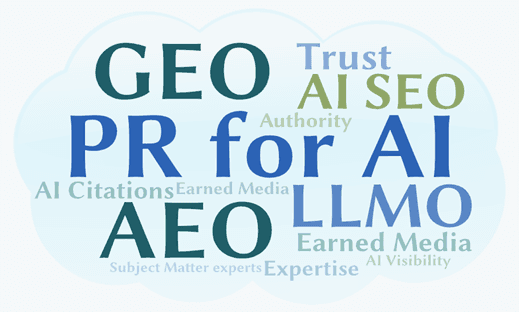
GEO, AEO, AI SEO, LLMO, “PR for AI”, Oh My!
Cut through GEO, AEO, and AI SEO jargon. Learn why earned media, credibility, and PR strategy drive real AI visibility and trusted answers.

Alex Crabb
President
What's the Difference (and Does It Even Matter)?
I was recently asked: "What's the difference between GEO and AEO?" Then came questions about AI SEO, and "What's LLMO?" Some people just want a simple explanation: "What is GEO?"
Here's the honest answer: These acronyms are mostly describing the same fundamental shift in how content gets discovered and trusted in an AI-first world. The names change faster than the strategies.
If you remember one thing, make it this: AI visibility is increasingly less about ranking in a list of links and more about becoming a reliable source in the answer. That requires clarity, credibility, and consistency, not tricks.
A plain-English definition of each term:
GEO (Generative Engine Optimization) is about making your content discoverable in AI-generated answers (think Perplexity, ChatGPT responses, or Google AI Overviews). It's about becoming part of the synthesized output, not just ranking in a list of links.
AEO (Answer Engine Optimization) is about optimizing to be the source an AI cites when someone asks a question. This often emphasizes clear, concise, question-driven content that can stand alone as "the answer."
LLMO (Large Language Model Optimization) is the same idea, rebranded for the AI-native crowd. It involves making your content, data, and brand signals easy for large language models to understand, retrieve, and reuse accurately over time.
AI SEO is the broad umbrella term marketers use when they want to sound current. It sort of lumps everything together.
PR for AI seems like accurate framing as we explain to clients and potential clients what we’re trying to do with our programs. We're essentially doing traditional public relations but with the explicit goal of building the kind of earned credibility that AI systems love to cite.
The Data Doesn't Lie: Earned Media Still Rules
Recent analyses of millions of AI citations show that the vast majority come from non-paid sources. Not sponsored content. Not press release wire pickups. Earned coverage, which is the kind that happens when a credible third-party media outlet covers you, when your spokespeople are quoted, and when your ideas and knowledge show up in publications people trust.
How AI discoverability works is exactly how traditional credibility was built. Authoritative sources get cited. Trust compounds over time. Relevance is earned.
The brands asking "how do we show up in AI search?" are really asking "do we have genuine credibility in our category?" If the answer is yes, the AI visibility tends to follow. If not, no amount of optimization tricks can manufacture it.
The acronyms change. The underlying work doesn't.
So, What Does Effective GEO/AEO/LLMO Work Look Like in Practice?
We're all still figuring out the perfect playbook, but one thing is clear: consistently creating authentic, authoritative, expert-driven content, and getting it amplified through earned media, is the most reliable path.
Here's how we recently approached this with a client in a highly technical space:
Start with the audiences: Identify the core groups we're trying to reach (e.g., technical decision-makers, end-users, early adopters, investors, industry influencers).
Mine real expertise: Work directly with subject matter experts (in this case, some of the world's leading voices in their technology). Ask: What questions do audiences ask you most often? What important topics aren't getting asked yet that we should proactively build awareness around?
Build a content matrix: Map those insights into a mix of formats such as blog posts, in-depth articles, whitepapers, contributed bylines, Q&As, and media pitch angles/storylines.
Target the right amplifiers: Research and build relationships with the journalists, outlets, and thought leaders who already hold authority in the space and cover it credibly.
Execute and iterate: Pitch stories, write and place content, align with editorial calendars, offer expert sources, and follow up relentlessly, but do it with savvy.
Measure: what are your search parameters? Check these across the various AI engines to check for growth in authority signals.
That's what I call PR for AI. Or, even better, just great PR.
Final Thought
Don't get lost in the alphabet soup. Whether you call it GEO, AEO, LLMO, or AI SEO, the winning approach in 2026 is about doing the timeless work of earning trust through expertise, transparency, and consistent storytelling in places that matter. It will never be about chasing the latest buzzword.
AI isn't replacing credibility. It's going to be about those who already have it.