What I’m Still Thinking About After Attending Parks Associates CONNECTIONS
After attending Parks Associates CONNECTIONS conference, Caster reflects on the smart home trends shaping the industry, from AI and presence detection to industry collaboration, networking, and the future of connected living.

Peter Girard
Senior Vice President
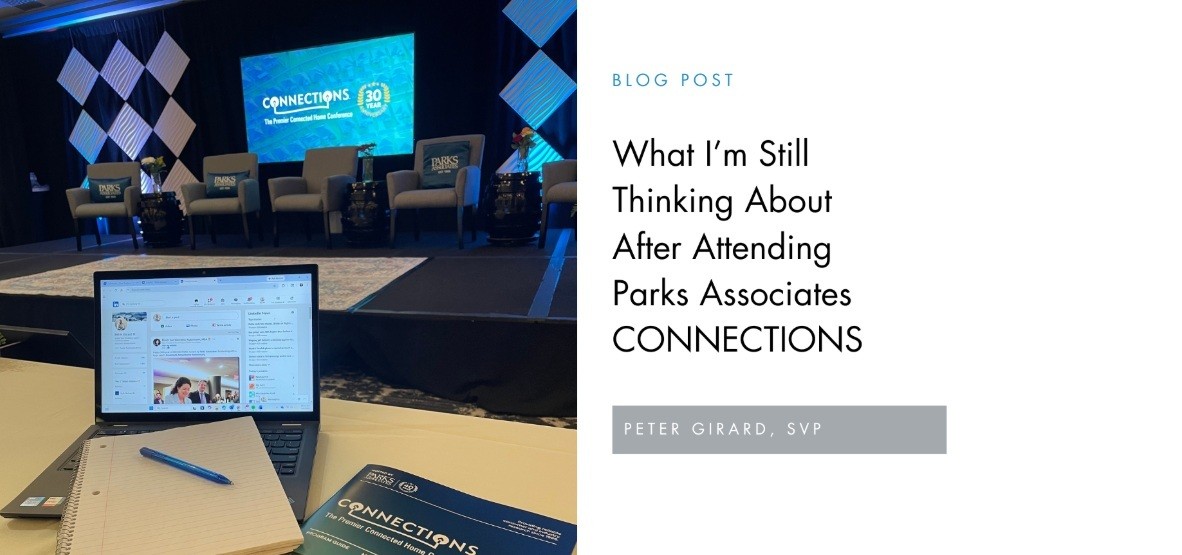
After a few solid days at Parks Associates CONNECTIONS which took place May 5-7, 2026, I came home with a full notebook, a stack of new business cards, a lot of data, insights and trends bouncing around my head. AKA, all the signs of a worthwhile event.
While I have attended my fair share of conferences where I’ve left with some interesting tidbits and some follow emails to send, CONNECTIONS is a unique event because the value is by no means limited to what happens on stage. The sessions are always strong, and this year was no exception, but the real benefit comes from the conversations that happen between, around, and because of them.
For Caster, that makes this event valuable on two different fronts. For starters, this event provides us with meaningful face time with attending clients who are there to learn, network, and stay connected to where the industry is headed. Second, it places us in the room with new companies, industry voices, and even partners who are engaging with the connected home and building environment in a serious way.
The key takeaway from Parks Associates CONNECTIONS 2026
If I were to provide a single high-level takeaway from CONNECTIONS, it is that the smart home industry is entering a new phase where AI, presence detection, value-added services, and interoperability are overlapping in more significant and meaningful ways. The industry is no longer talking about whether or not devices can connect or if connectivity is possible.
The conversation has evolved to include what those connections enable, how to build sustainable business models around those connections, and how the ecosystem at large can work together to deliver the experience people actually trust and use.
How did AI dominate the conversation at CONNECTIONS 2026?
This should not come as a surprise, but AI was omnipresent at this conference.
AI was referenced across almost every single session topic, chatted about over the provided breakfast and lunch, and included in the broader market outlook discussions. Yes, AI is important, but what I found particularly interesting was just how many industry attendees expressed that the “AI era” arrived much faster than expected. Even those who believed AI would be transformative seemed surprised by just how quickly it moves from being a future-facing concept to an immediate strategic priority.
Where discussion around Matter over the past several years previously took up a significant amount of oxygen in smart home conversations, that seems to have shifted. Matter was still part of the broader conversation, but alongside other connectivity protocols such as Z-Wave and Thread. AI felt like the dominant theme running throughout the event.
This shift is significant because it means AI is pushing companies to think differently about the connected home and building environment. It is no longer enough simply to connect devices; the value now is tethered to the intelligence and context that can be provided alongside the automations and services that can be layered on top of that.
Why is collaboration still the only way forward in the smart home industry
For all the chatter around AI, one of the clearest themes from CONNECTIONS was something much more familiar to everyone in attendance: collaboration.
The smart home industry has always required a certain level of cooperation between companies that, quite simply, compete with one another. While “coopetition” is not a new concept, it felt especially relevant this year. As the industry collectively advances into more complex territory involving AI, added services, security, privacy, interoperability and data-driven experiences, no single company or technology can solve every single challenge in a silo.
Critically, one point that the conference really drove home for me was that all of the progress that we’re able to talk about today is built on decades of ecosystem work. Parks Associates, for example, is celebrating 40 years in business and 30 years of the CONNECTIONS event. That history is significant. The smart home did not appear overnight. It has been shaped by the numerous manufacturers, platforms, service providers, standard bodies, integrators, analysts, researchers, and the type of people who do not shy away from sitting in rooms together to discuss and work through problems.
Why is “security” still a careful word for ISPs and service providers
To me, one of the more interesting threads to come out of the conference was how services providers and ISPs talk about security adjacent services.
There is real caution and hesitancy around positioning too directly as “security,” even if the technology being discussed may involve cameras, monitoring alerts, or other services that customers could easily associate with security. That caution is not without merit. “Security” carries a significant amount of weight, but perhaps more importantly, it carries liability.
Directly out of some of the on-stage sessions, companies that do not want to be tied direct to security care about the language that ius being used. For example, the offering may be for “connected cameras” vs. referring to them as “security cameras”. The distinction might feel slight, but I think it reveals something about the overall state of the market. It shows that companies want to deliver more value into the connected home, but they are aware of the responsibility and weight that comes with certain categories.
What did CONNECTIONS 2026 reveal about the next generation of smart home innovation?
To me, one of the highlights of the event was the way it balanced the future of the industry with the recognition for the people who have helped build it.
For the closing session of day two, a young entrepreneur took the stage and was the epitome of the future-facing energy that still exists in this space. Put simply, it was an absolute joy to hear from Shanya Gill and learn about her AI-powered fire detection system that she built after experiencing a fire near her own home. It was a powerful reminder of why this industry still has so much room for new ideas, and new people to think those ideas up.
I am not the only one, but part of what stood out to me about Shanya’s session was not the technology itself, but rather the thinking behind it. Her unyielding focus on simplicity, the user experience, and her thoughts on data privacy and subscriptions as a teenage entrepreneur were refreshing. Those are exactly the types of consideration that connected home industry will need to continue prioritizing.
At the same time, Parks Associates also took the time to recognize 40 technology leaders who have each contributed to the growth and development of the industry. Among those names were many I recognize and have the privilege of working alongside every day, but chief among them is Caster’s founder, Kimberly Lancaster, which is incredibly well-deserved and was a proud moment for our team.
The connected home still has a lot of work ahead, but it also has an incredibly strong foundation of people who have been pushing it forward for decades.
What smart home trends should we watch next after CONNECTIONS 2026?
By no means is the smart home industry standing still. AI is accelerating that conversation and technologies like presence detection (which I am keen on following closely) is becoming increasingly meaningful. I take comfort in the fact that collaboration remains essential to the success of the industry, and it is events like CONNECTIONS that provide the kinds of focused, relationship-centric environments that empower professionals to take a step back, compare notes and figure out what comes next.
Major thank you to the Parks Associates team for another excellent CONNECTIONS and congratulations on 40 years in business and 30 years of bringing the industry together.