Press Releases: to wire or not?

Kimberly Lancaster
Founder

Search Engine Journal stated AI search barely cites syndicated press releases. “Data from 4M AI citations shows syndicated press releases barely register in AI answers. Editorial content and owned newsrooms fare better.” This is a meaningful data point, but it is not quite the “death of the wire” moment some are going to frame it as.
Here is how to interpret it, and more importantly, how to act on it.
The core findings
Syndicated press releases have near-zero impact
They “barely register” in AI answers
Even when indexed and crawlable, they are rarely cited
Original editorial content dominates
The vast majority of citations come from independent reporting and analysis
AI systems prioritize content that adds value, not repeats it
Owned content performs better than wires (but still secondary)
Company newsrooms show some traction, especially on certain AI platforms
Still far behind third-party editorial sources
There is a disconnect with wire service positioning
Many distribution services market press releases as “AI visibility tools”
The data does not support that claim
What most people will get wrong:
The easy, but flawed takeaway “Press releases do not matter anymore.” That is not accurate. This means earned media carries significantly more weight in AI visibility than syndicated press releases.
Press releases were never meant to be the outcome. They are inputs to:
journalist discovery
message control
SEO indexing
stakeholder communication
What this data shows is that distribution alone is not influence.
What actually matters now:
Earned media is now dual-purpose
It is no longer just about credibility with humans. It is about:
training data exposure
citation eligibility in AI answers
By example, a Reuters mention is now doing three jobs:
brand validation
search visibility
AI inclusion
That is a material shift.
2. Editorial quality beats distribution scale
AI is rewarding:
comparative analysis
third-party validation
expert framing
It is deprioritizing:
templated announcements
duplicated content
promotional language
This puts pressure on PR to think more like media, less like distribution opportunities.
3. Owned content is your control layer
One platform-level finding stood out. Internal press releases and newsroom content on company-owned domains accounted for 18% of ChatGPT’s citations in the dataset. This matters.
It means:
your newsroom still plays a role
but it must be written for utility, not announcement
Think:
explainers
data-backed insights
FAQ-style content
perspective pieces
Not:
“Company X announces…”
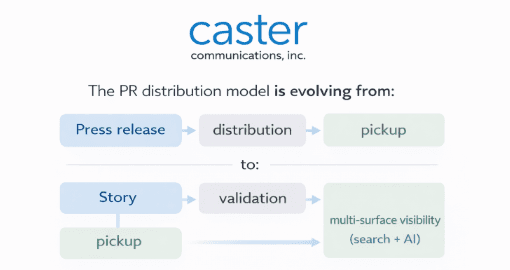
The model is evolving from:
Press release → distribution → pickup
to:
Story → validation → multi-surface visibility (search + AI)
What I would tell clients right now
Do not cut wire. Reposition it.
Double down on earned media strategy, not just outreach volume.
Invest in story development, not just announcements.
Upgrade owned content into something AI would actually cite.
Start tracking “AI citation visibility” alongside traditional coverage.
This is not a disruption of PR fundamentals. It is a reweighting. The data challenges a premise that press release distribution services have been promoting. Multiple distribution platforms now market press releases as a path to AI visibility.
The firms that win will be the ones that have always prioritized:
strong narratives
real relationships with media
substance over volume
AI is simply making that visible in a new channel. As SEJ noted, “Businesses investing in digital PR may want to look more closely at how different distribution channels perform in their category. Data suggests the channel you use can affect where your brand gets cited.”