Trade Show PR Support for CES, CEDIA, InfoComm and Beyond
Trade show success starts long before the exhibit hall opens. Learn how PR strategy, awards, speaking, media outreach, social support, and post-show follow-up help brands maximize CES, CEDIA, InfoComm, and other major events.

Rachel Bradshaw

God, I love a show. From my first big role as Joseph in Joseph and the Amazing Technicolor Dreamcoat, to a decade-plus as a trade show organizer for one of the biggest tech shows out there, I’ve never been able to resist the high of performance. You practice, critique, and perfect internally — then you share what you’ve built with the world and see how it’s really received. And if you’re a true pro, once the curtain falls, you hoover up all the reviews and use them to fuel your passion to innovate.
A show is so much more than a performance: it’s everything that came before and after. That’s doubly true for trade shows. CES is one of the biggest stages in tech, but the same principle applies to CEDIA, InfoComm, IBC, KBIS, ISC West, and nearly every major industry event where brands are competing for the attention of media, customers, partners, analysts, influencers, and industry decision-makers.
A great performance takes considerable advance work, but even an award-worthy performance does not matter if there is no follow-through. You need to be ready to both grab and hold that spotlight, and an experienced director can make all the difference.
Caster works with clients before, during, and after major trade shows to help them make the most of the investment. If you’re planning to exhibit at CES, CEDIA, InfoComm, or another major industry event, here’s a glimpse into the role full-service PR plays in trade show strategy.
Quick Answer: What Trade Show PR Support Do Companies Need?
Trade show PR support helps companies plan, promote, execute, and extend their presence at major industry events. A strong trade show PR strategy may include event selection, messaging, speaking submissions, awards strategy, press releases, media outreach, press appointment scheduling, onsite briefing support, social media content, event support, post-show follow-up, and reporting.
The goal is not just to generate booth traffic. The goal is to turn a trade show appearance into media coverage, brand awareness, executive visibility, third-party credibility, sales support, stronger relationships, useful content, and long-term discoverability.
Trade Show Strategy Consultation
As part of our year-round PR strategies, Caster helps clients identify target events, assess their value, and plan the right level of presence. We weigh factors like attendance size, audience demographics, media coverage, exhibitor profiles, category relevance, and timing against the client’s goals, roadmap, capacity, and budget.
Related: Leveraging the Momentum: PR Strategies that Maximize Trade Show Success
There is a full spectrum of engagement to consider, from “attend, listen, and learn” to “host invite-only meetings in a suite” to “commit to a major booth and headline sponsorship.” Caster helps clients outline a strategy to maximize their return at every level.
An event like CES has multiple avenues for engagement with press, analysts, partners, influencers, customers, and other target audiences. The same is true for vertical shows like CEDIA and InfoComm, where the audience may be more concentrated, technical, channel-focused, or dealer-driven. Caster helps clients calibrate the strategy to match their goals and budget, while still looking for media, awards, content, and relationship-building opportunities at every level.
Speaking Opportunities
The call for presentations at CES 2027 is open now. That’s actually a pretty short window – events frequently build out their programs a year or more in advance.
Caster maintains opportunity calendars for our clients, tracking the events they plan to attend and the shows where they would like to have a thought leadership presence. When a call for speakers opens, we assess the criteria, review past programs, and talk with our clients about how they can meaningfully contribute to the conference’s goals while advancing their own communications priorities.
Then, we develop and submit abstracts and supporting materials, often working directly with conference organizers to ensure our recommendations are aligned with their needs.
Once a session is accepted, the work really begins. Caster helps clients fulfill their obligations as speakers, track materials deadlines, support content production, and hold panel prep calls to ensure the final session delivers on the abstract’s promise. We also help promote sessions through social campaigns for clients and Caster.
Awards submission
Caster’s opportunity calendars also track awards. Official show awards, media awards, innovation awards, product awards, and “Best of Show” programs are common at major trade shows. For official programs, clients often need to start early.
More broadly, Caster works with clients to set priorities for which awards to pursue, considering impact, budget, audience, feasibility, eligibility, and promotional value. We craft submissions, source supporting proof points, and work with external stakeholders to gather testimonials, case studies, product details, imagery, or performance data when needed.
Trade show awards can be especially valuable because they create third-party validation at a moment when media, partners, dealers, and customers are already paying attention. A strong award win can support press outreach, website credibility, sales enablement, social content, executive visibility, and post-show momentum.
Caster also pitches media who adjudicate awards onsite, an approach that can pay huge dividends even when product information is not available until right before the show.
Trade Show Media Outreach
Press rooms and budgets are shrinking, meaning that even for a show like CES, the onsite press corps is busy and discerning. Caster helps clients make sure their news is a priority.
Unless you’re launching a new company, trade show media outreach should build on an existing bedrock of thought leadership. The media should already know your brand and subject matter experts and trust that talking to them at the trade show will be worth their precious, limited time. Caster works with clients year-round to establish that reputation so that trade show media outreach is a continuation of an ongoing relationship, not a cold call.
We work with clients to define a “news hook” for the trade show. This could be a product announcement, partnership news, original research, new use case, case study, or demonstrations, etc. The goal is to generate FOMO. We want to offer an opportunity – to ask key executives deep questions, to grasp a revolutionary new concept before anyone else, to get a video clip that’s going to go viral – that they can’t get any other time. We often craft an official announcement around this “news hook” and use it to reel in press appointments.
Pre-Show, At-Show, and Post-Show Briefings
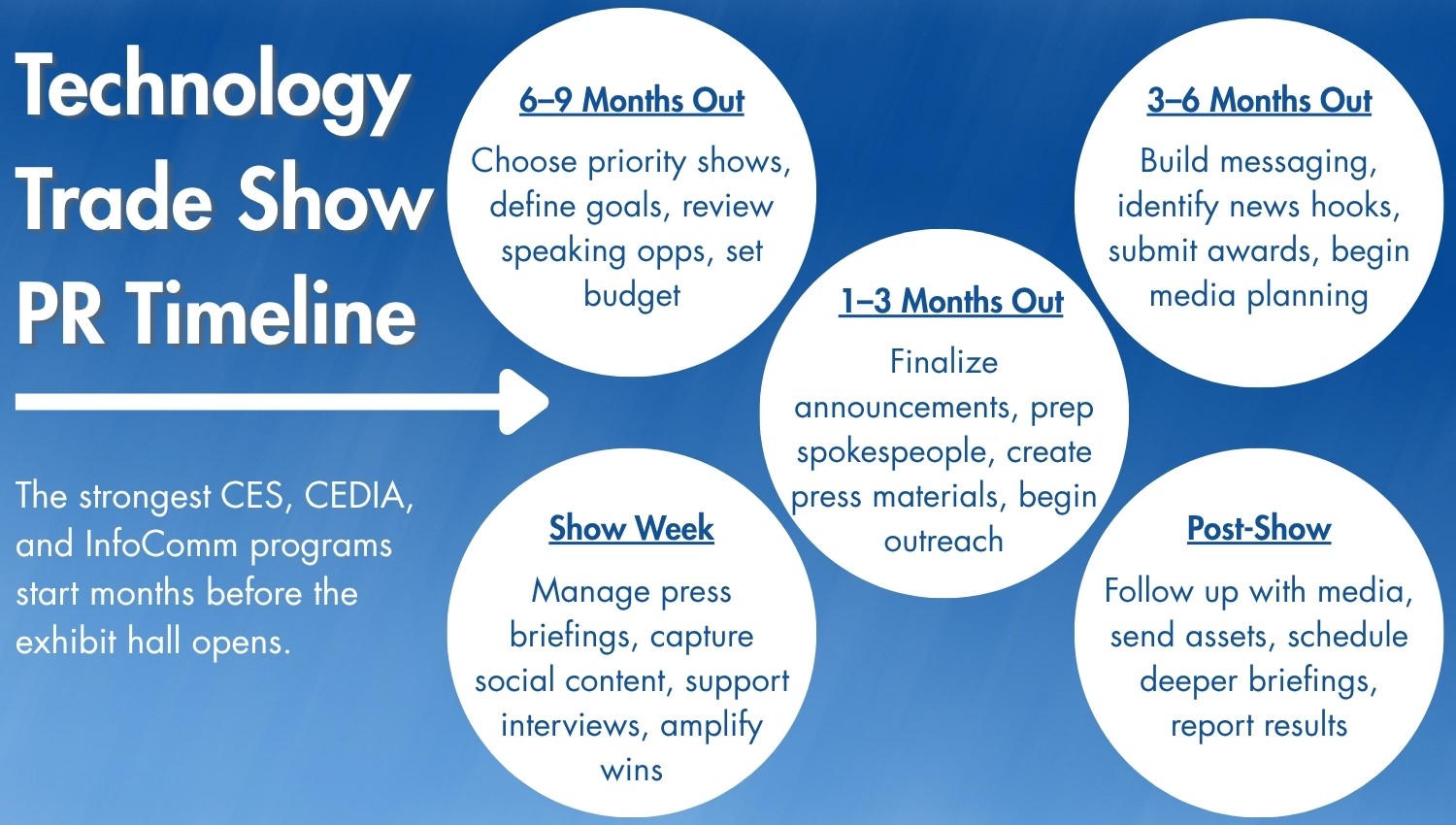
In the modern era, trade show PR does not happen only on the show floor. Caster supports briefings before, during, and after a show.
Embargo briefings before the show allow us to seed stories and help secure same-day coverage for at-show announcements. They also help us tell deeper stories. Often, press members have only a few minutes to spend in a booth: enough to grab photos or video clips, see a demo, and ask one or two surface-level questions. A pre-show briefing provides the context that helps the at-show experience really hit.
At the trade show, Caster maintains a schedule of press appointments and promised stop-bys. We prep clients — who, at this point, should already have media training — with likely questions, key messages, and briefing goals. We stay close to our friends in the media, coordinating as schedules inevitably shift onsite. We also look for organic opportunities, spotting journalists and influencers and bringing them to visit our clients when there is a relevant fit.
Post-show briefings allow us to go deeper with press and analysts who either did not attend the show in person or had a brief stop-by and want to know more. Post-show engagement is crucial. Making a huge splash at a trade show and then falling off the map can make a company look like vaporware. That damaged credibility puts your next announcement or outreach effort in jeopardy.
What Trade Show PR Results Can Look Like
A strong trade show PR program should create visibility that extends well beyond the booth. For Caster clients, that has meant turning CES, Pepcom, CEDIA, and other major event moments into national media coverage, product validation, executive visibility, and content that continues working after the show ends.
For Abode, Caster helped support visibility around the brand’s Pepcom and CES 2026 cycle, including the AT&T Connected Life announcement. The campaign generated coverage from major consumer technology and smart home outlets including Forbes, WIRED, PCMag, The Verge, and SafeWise. That kind of media mix matters because it reaches both mainstream technology readers and the more specific smart home audiences evaluating connected security, backup connectivity, and home automation solutions.
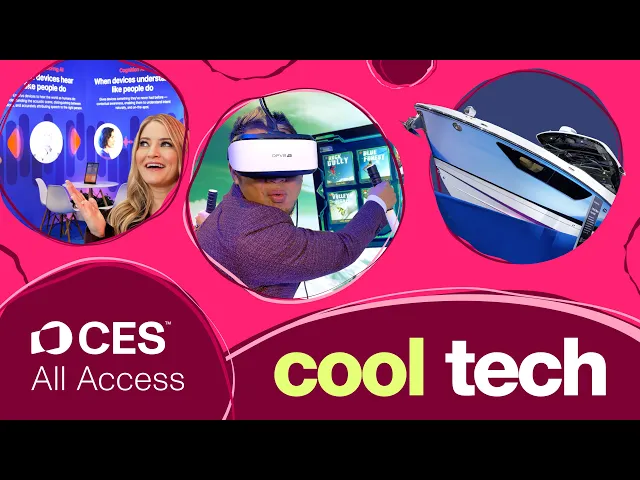
For Kardome, CES 2026 created a different kind of opportunity: demonstrating complex voice AI technology in a real-world environment. Kardome’s Spatial Hearing AI and Cognition AI were featured in an official CES “coolest tech” segment, where hosts experienced an in-vehicle demo showing how the system could identify who was speaking, understand location and intent, and respond naturally without traditional wake words:
Kardome also used CES to reinforce its broader product story around on-device, context-aware voice AI for vehicles, kiosks, public spaces, and other noisy environments.
These examples show why trade show PR is most effective when it is planned as a full communications program, not a single announcement. The strongest outcomes usually come from connecting pre-show strategy, clear messaging, media outreach, onsite demos, executive access, awards or recognition opportunities, social content, and post-show follow-up into one coordinated effort.
Onsite Social Support
Caster also offers onsite social media support for clients. We plan show-specific campaigns and build out a shot schedule to ensure a client’s award wins, speaking engagements, packed booths, parties, and more have the maximum reach. Trade shows also present a key opportunity to gather media assets that support clients’ year-round social programs.
Social support from Caster leaves clients free to focus on their primary trade show goals: connecting with partners and customers. The assets and posts we create help deepen those relationships, creating new touchpoints as we tag and share.
Going to a tech trade show? Contact us to help plan for success.
Event Support
Like all Caster programs, trade show support is customized to our clients’ needs. Many clients host their own events at key trade shows – and Caster, as always, is in their corner. We offer event support services ranging from event messaging to end-to-end design and execution. From intimate press dinners to essential customer roundtables, Caster curates events that help strengthen clients’ more important relationships.
Trade shows are an essential touchpoint – but they cannot stand alone as a tactic. Once the curtain falls, the larger communications journey must continue. At Caster, we map and travel that path together with our clients.