How Long Does PR Take to Work?
PR timelines vary by goal, but most programs follow a predictable arc: 30 days of messaging groundwork, media relationship-building through day 60, and initial results within 90 days. Learn what to expect and how to measure success.

Rachel Bradshaw

It’s a conversation we have with every client who’s dipping their toes into proactive PR outreach for the first time: how long is this going to take to work?
The obvious, annoying answer is, “it depends.”
What’s your goal, and how will you assess whether you’ve reached it? Are you trying to increase your digital reach, like AlarMax in 2023? Do you want to dominate an awards cycle like the Hunter Douglas Aura Illuminated Shades? Are you looking to garner mainstream attention on a new brand launch, like when the Khronos Group bootstrapped the Metaverse Standards Forum?
Different goals, different timelines, different metrics. There’s no “one-size-fits-all” PR program: that’s why our first conversation always centers around what you want to accomplish and why. That said, we can lay out some close-to-universal expectations about your PR program timeline.
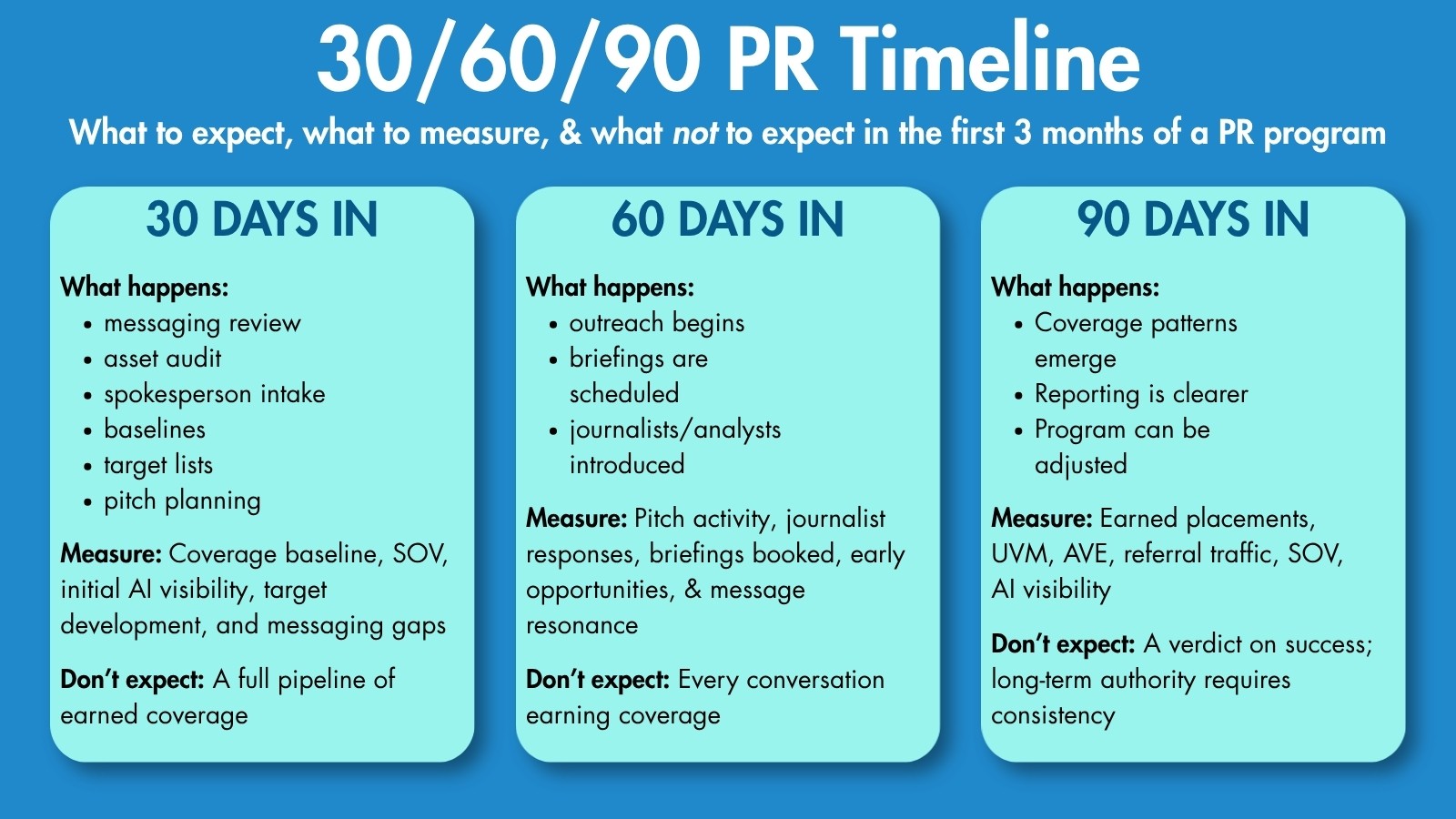
In short: most PR programs need 30 days to establish messaging and baselines, 60 days to begin meaningful media relationship-building, and 90 days to assess early results. PR can start working quickly, but lasting visibility, share of voice, and AI visibility require consistent outreach over time.
Reality Check: PR is a Top-of-Funnel Activity
Clients often tell me, “I’ll know if the program is working if I see an increase in sales.” Whoa there, pal: that’s not in PR’s control. We are building awareness of your brand, shaping sentiment, and driving interest, but we cannot be soley responsible for audience engagement, conversion, and loyalty. Sales is a muddy signal. As much as I’d like to take full credit when clients tell me they’ve had a record year, there are too many other factors at play.
There are other metrics that will more accurately reveal the efficacy of your PR program:
Earned media placements: basic but indispensable. Are relevant industry publications covering you? Are earned placements increasing YoY? Are you growing your reach by breaking into new outlets?
UVM (Unique Visitors Monthly): how many unique visitors does each publication in which you’ve earned placement see each month? This gives you a rough estimate of the potential audience for all your earned media placements.
AVE (Advertising Value Equivalency): if you had to buy this coverage, how much would it cost?
SOV (Share of Voice): How much of the industry conversation is about you versus your primary competitors, and how is that proportion changing over time?
AI Visibility (GEO): How often is your brand or company cited by leading AI models in response to target questions?
For most of these metrics, it takes a little while for the signal to emerge from the noise. Certain metrics, we typically only begin tracking 60 days or more into a program (more on why below). Other metrics, like AI Visibility and SOV, can and should be assessed immediately as a baseline.
These numbers are also a little easier to goose: one great media cycle can instantly transform your AI Visibility. Unfortunately, the reverse is also true: if you go quiet or your competitors ramp up their media outreach and content production, your AI Visibility and SOV can tank fast. Good GEO and SOV take constant upkeep.
This leads me to two points:
Unless your goals center around a single, time-bound event like a launch or a tradeshow, it’s going to take a few months to tell if your PR program has started working.
Your goals should not center around a single, time-bound event. Who cares if you have good GEO or SOV for a day? You need them year-round.
What Happens in the First 30 Days of a PR Program?
Caster prides itself on becoming a truly embedded member of each client’s team. When we reach out to media on your behalf, we want to fully understand your story so we can persuade the media it’s interesting. So, most programs start with a “getting to know you” period.
We will inhale your current messaging documentation, including pitch decks, thought leadership content, competitive analysis, audience personas, and case studies. We’ll talk to your key spokespeople, both to get their unvarnished perspective and to assess their press-readiness. We’ll establish baselines for coverage, AI Visibility, and share of voice and build opportunity calendars and target lists so we can begin transforming your media relations.
We’re not just exploring your house in this early period: we’re sketching blueprints for the remodel. The extent varies from subtle design flourishes to gut renovation, but every new client’s messaging structure needs some amount of work.
Maybe you already have well-defined messaging that’s working for your sales and social teams, but you need to amplify your reach. Caster works to develop a pitchbook that will resonate with media and influencer targets.
However, many new clients don’t have a messaging playbook, or the one they have is in serious need of a refresh. Caster can work with your existing assets and interview internal and external stakeholders to develop a SWOT analysis, foundational messaging, and FAQ set. If needed, we also train spokespeople to leverage these assets, holding mock interviews to prepare them for their first media engagements.
The First 60 Days: Meet the Press
Once we’ve established a messaging baseline, it’s time to ramp up media outreach. In this period, we want to clearly establish for target media that you’ve got something to offer beyond press releases: a unique perspective, genuine innovation, clear-eyed industry analysis, or actionable advice.
We want them to see you as a resource who can help them tell a batter story or capture audience attention. It’s a symbiotic relationship. The more value you offer to press, the more valuable coverage you’ll receive.
In this period, we’ll likely look to book some initial briefings with press and relevant analysts. We’re looking to build understanding of how your organization fits into their beat and what your subject matter experts have to offer.
Then, when you do have an announcement, they are far more likely to cover it, because they understand why it’s important to the bigger picture.
If you do have a news hook, e.g. an announcement or a launch, so much the better. A hard news story is a good mechanism for introducing yourself to press. But remember: getting them to understand your deeper story and follow you post-release is the real goal. You don’t want to be a flash in the pan.
The First 90 Days: Assess, Adjust, Advance
Once media outreach is underway, we’ll start tracking earned media, UVM, and AVE on a monthly basis.
Now, we can begin to form a clear picture of what the program is accomplishing. We can also begin to drill down: which press verticals get it, and which haven’t bought in yet? How can we adjust our approach to reach the holdouts?
We can begin to track how various activities impact AI Visibility, social engagement, and web traffic. As the program proceeds, we’ll adjust tactics to make sure we’re advancing your goals efficiently. Within 90 days, we should be able to assess how well your PR is working, and what we need to do next.
That’s not a finish line: there’s no moment of “PR worked! Now we can relax.” Even if you pause proactive media outreach, every public action has PR implications. If you stop tending to your public presence, you just cede control. PR can start working pretty quickly. Keeping it working is the important part.
Whatever your PR goal, Caster has been there. We’re more than happy to share our experience and figure out what it will take to achieve your vision. Reach out and let’s talk about how we can help.