What “Good Coverage” Looks Like for Tech Companies
What “good coverage” really looks like for tech companies: use a simple rubric to score placements by impact, credibility, and AI-cite-ability (not vanity hits).

Adam Forziati

Tech companies often measure PR success the same way they measure social media: “Did we get a hit?” “Can we post it on LinkedIn?”
But “good coverage” doesn’t just look impressive. It builds credibility with the people who can buy, recommend, install, or shortlist your product. In 2026 and beyond, it’s also the kind of coverage that becomes reusable input for buying guides, partner conversations, and AI-generated answers.
Here’s how to sort the quality coverage from the vanity hits.
The short definition of “good coverage”
Good coverage changes perception. It makes your company easier to trust, explain, and recommend. Ideally, it does that from a platform that already has credibility with your customers.
That’s why a hands-on review that crowns a product “best in category” can have a higher value than the press release that announced the product in the first place. This Magnetar review from Residential Systems is a good example. It doesn’t just mention the product: it stakes a position (“best universal disc player”) and explains why, with real detail and attribution.
Related: U.S. Product Launches: PR Strategies that Actually Work
Why this matters more in the AI era
AI tools largely remix what the internet already treats as credible, meaning the coverage that tends to show up in AI answers is the coverage that already has:
Clear definitions and explanations
Reputable publishers
Concrete details
Consistent positioning
Network World’s “What is edge AI?” feature is a model example: it defines the concept clearly and includes expert quotes (including Caster Communications client Kardome’s CEO) that add architectural context. That structure is inherently “cite-able” in today’s LLMs.
A simple rubric to score coverage quality
If you want to know whether PR is “working,” you need a way to grade outcomes that’s more meaningful than clip counts. Here’s the Caster Coverage Quality Scoring Rubric to judge the quality of your earned media clips:
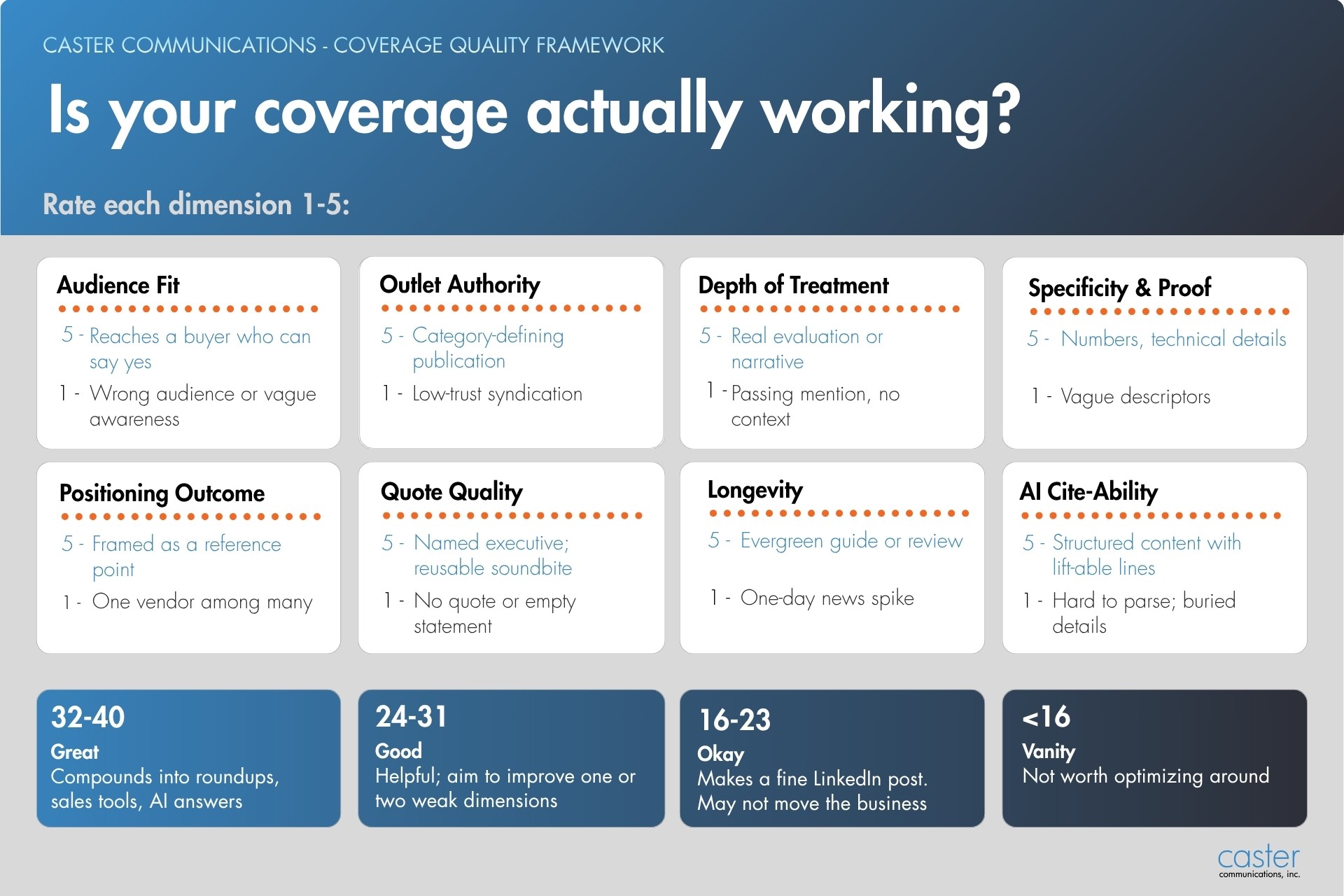
The Coverage Quality Score (40 points)
Score each placement 1–5 across these eight dimensions:
Audience fit
Outlet authority
Depth of treatment
Specificity & proof
Positioning outcome
Quote quality
Longevity
AI cite-ability
Example: SDxCentral’s NLM Photonics section scores well because it contains technical explanation and concrete claims (including size and throughput context) via the CEO’s quotes; exactly the kind of specificity that becomes a reference point later.
What high-scoring coverage looks like in practice
1) A review that makes you the default choice
The most durable kind of product coverage is the kind buyers can use to decide.
Residential Systems’ Magnetar review is a textbook “high-score” placement: it’s deep, comparative, and confident about where the product sits in the market. It also includes executive context and addresses misconceptions directly (which strengthens trust).
2) A mainstream mention that frames you as the category solution
Mainstream mentions can be powerful when they do more than list you. The Verge doesn’t just include Magnetar as a deal; it frames the brand as filling the void left by Oppo’s exit, names specific models, and gives pricing context. Again: positioning, not just placement.
For consumer-facing tech, good coverage is often the combination of (a) a trusted outlet, (b) a direct recommendation, and (c) a quote that adds expert credibility. Condé Nast Traveler does exactly that by naming Caster client Loxx Boxx as the recommendation and quoting their CEO about why their solution reduces theft risk and weather exposure.
Homes & Gardens reinforces that authority again with an expert quote plus clear guidance: if you want to stop porch theft, the physical solution is the reliable one.
3) A trade byline that reaches the people who specify and recommend
For many tech categories, trade and channel media are where buying influence lives. A byline can be “good coverage” when it’s authored by the right executive, published in the right trade, and makes a clear argument that helps the reader do their job.
4) An evergreen explainer where you become a trusted source
If you’re in an emerging or technical category, the “best” coverage is often one that helps define precisely what it is that you do.
These CIO and Network World pieces are both examples of formats that AI systems love because they are structured as explainers and “things you should know,” bolstered with expert sourcing.
CIO’s AI/data center piece, for example, explicitly positions Caster client NLM Photonics’ CEO as a credible voice and contextualizes why his perspective matters.
5) Awards and “companies to watch” as credibility accelerants
Awards and curated “companies to watch” lists are a different kind of win: they’re fast credibility signals that are easy for you to reuse in different channels. Residential Tech Today naming our client Alfred’s Interconnect Kit as a 2025 Innovation Award Winner is a clean example of third-party validation.
6) Enterprise trade coverage that ties your product to a real operational problem
“Good coverage” in B2B often looks like expert quotes, market context, and product implications. TechTarget’s hybrid meeting hardware feature does this by quoting our client Crestron’s leadership and connecting the brand to a macro problem (hybrid meeting equity and infrastructure maturity), then listing relevant product capabilities.
Coverage that looks good, but isn’t
If you’ve thought about PR and marketing for long enough, you’ve seen placements that look impressive but don’t actually change anything. Common reasons for this include:
Wrong audience
No differentiation
No proof
No quote
No positioning outcome
Not reusable anywhere else
If a prospect asked, “Why should I choose you?” could you point to the coverage and say, “This is why,” without needing to explain it all yourself?
If not, it’s probably not worth your time.
How to build a PR program that earns high-scoring coverage
High-quality coverage is rarely accidental. It typically comes from the same upstream work, repeated consistently:
Clear positioning (what conversation are you joining?)
Proof points (what’s true and verifiable?)
The right targets (who influences your buyers?)
The right format (review, explainer, byline, trade, awards)
A cadence that keeps you in the spotlight
This is why good coverage compounds: a strong review becomes a buying guide reference; a definitional explainer becomes an AI citation source; trade credibility makes channel conversations easier; awards reduce friction in “new vendor” discussions.
Caster Communications can help you score your recent coverage using the above rubric and identify which dimensions you’re missing (depth, targeting, proof, or longevity). If you’re trying to earn more of the kind of coverage that compounds (reviews, explainers, trade authority, and credible third-party validation), reach out through our Contact Us page.